A digital disposable camera.Without the developing bill.
Disposable cameras on every table is a lovely idea that reliably disappoints - half go missing and a third of the frames come out black. Here is what a digital party camera keeps, and what it genuinely gives up.
Create Your Album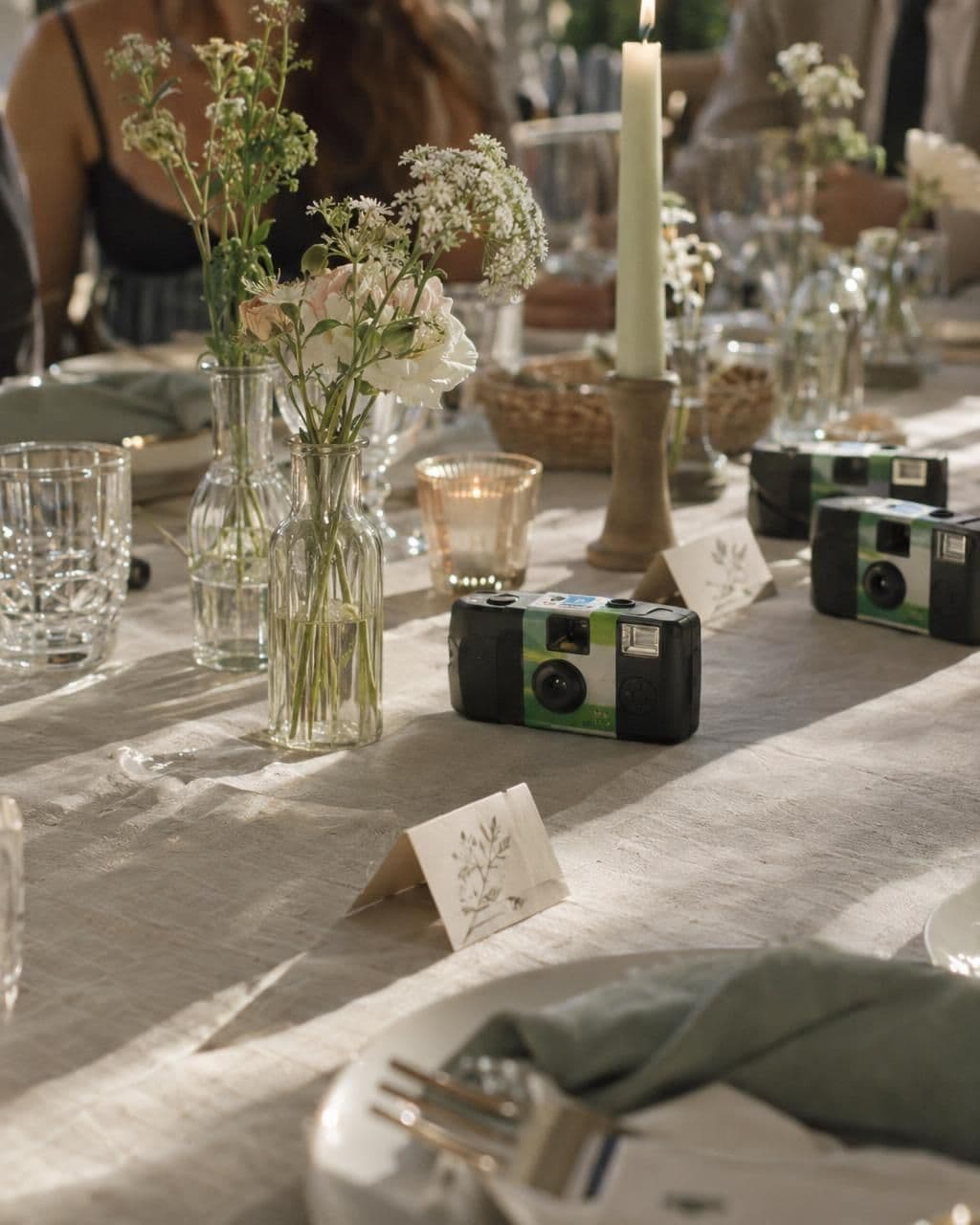
What a digital disposable camera actually is
It is a shared photo album with a deliberate constraint: guests take photos from their own phones into a communal gallery, and depending on the tool, they may not see the results until after the event. The camera is digital and the “disposable” part is the experience - shoot and move on, no reviewing, no retaking, no curating.
Two variants exist, and people conflate them. A reveal-later camera hides all photos until a set time, recreating the film-developing wait. A live shared gallery shows photos as they arrive. The first is more atmospheric; the second produces more photos, because guests upload more when they can see the album filling up. Some tools do both, with the reveal as an option.
Why actual disposable cameras disappoint (the maths)
Nobody wants to hear this because the aesthetic is genuinely charming. But the numbers are consistent enough to be worth putting in front of you.
- Cost. A disposable camera runs roughly $15 to $25, and developing and scanning adds $12 to $20 per camera. Ten cameras on ten tables is $270 to $450 before you have seen a single image.
- Yield. A 27-exposure camera has a fixed flash range of about eight to ten feet. In a dim reception, anything beyond that is a dark frame. Between that, thumbs over the lens, and blank shots, a usable yield of a third to a half is normal.
- Attrition. Cameras get pocketed, left in coats, taken home by accident, or found under a table in three weeks. Expect to lose some - and each loss is the whole roll, not one photo.
- Time. A week or more to develop and scan, on top of the weeks you are already waiting on your photographer.
Work it through and a table camera costs somewhere near a dollar per usable photo. That is not an argument against them - it is an argument for knowing what you are buying.
Digital versus film, side by side
| Digital disposable app | Film disposable cameras | |
|---|---|---|
| Cost for a 100-guest wedding | One flat fee, commonly $25-$150 total | $270-$450 for ten cameras, developing included |
| Photos you end up with | Hundreds to low thousands | ~270 exposures, of which maybe half are usable |
| Low light | Whatever a modern phone can do - usually fine | Flash reaches 8-10 feet, then nothing |
| Video and audio | Yes | No |
| Time to see results | Instantly, or at a reveal time you set | One to two weeks |
| Things that go missing | Nothing - photos upload as they are taken | Whole cameras |
| The tactile novelty | Absent - this is the real trade-off | Genuinely charming, and the reason people do it |
| Grain and colour character | Only if the tool applies a filter | Authentic, and hard to fake convincingly |
Digital disposable app
- Cost for a 100-guest wedding
- One flat fee, commonly $25-$150 total
- Photos you end up with
- Hundreds to low thousands
- Low light
- Whatever a modern phone can do - usually fine
- Video and audio
- Yes
- Time to see results
- Instantly, or at a reveal time you set
- Things that go missing
- Nothing - photos upload as they are taken
- The tactile novelty
- Absent - this is the real trade-off
- Grain and colour character
- Only if the tool applies a filter
Film disposable cameras
- Cost for a 100-guest wedding
- $270-$450 for ten cameras, developing included
- Photos you end up with
- ~270 exposures, of which maybe half are usable
- Low light
- Flash reaches 8-10 feet, then nothing
- Video and audio
- No
- Time to see results
- One to two weeks
- Things that go missing
- Whole cameras
- The tactile novelty
- Genuinely charming, and the reason people do it
- Grain and colour character
- Authentic, and hard to fake convincingly
What you genuinely give up going digital
Two things, and neither is nothing.
The object. A plastic camera on a table is an invitation. People pick it up because it is there, including people who would never think to open a link. Digital has no equivalent physical prompt - a QR card on a table is not as compelling as a camera on a table, and pretending otherwise is dishonest.
The look. Film grain, the blown-out flash, the specific way colour shifts on cheap film stock - digital filters approximate this and mostly do not convince. If that aesthetic is the point for you, an app is not a substitute.
The honest recommendation, if the budget allows: put two or three real cameras out for the novelty and the look, and run a digital gallery as the thing that actually captures the night. The cameras become a prop that people photograph each other using, and those photos land in the gallery too.
Party cameras beyond weddings
The same setup works for any event where the guests outnumber the cameras and everyone is holding a phone:
- Bachelor and bachelorette weekends, where photos otherwise fragment across four group chats and nobody assembles them.
- Bridal showers and engagement parties, which usually have no photographer at all, so guest photos are the only record.
- Birthdays, reunions, and milestone parties - the host is in the photos rather than taking them, which is exactly when a shared album earns its keep.
If you are running several of these across an engagement, check whether your tool covers multiple events on one purchase. Buying separately for each adds up fast.
Running one well
The failure mode for a digital camera is not technical, it is attention. Nobody uploads because nobody remembers. Five things fix that:
- Put the code where people already look. Table cards, the bar, the back of the menu, the bathroom mirror. One sign at the entrance reaches the first twenty arrivals and nobody else.
- Say it out loud once. An MC mention during the toasts produces a measurable spike. One mention is enough; three is nagging.
- Turn on the live slideshow if you have one. Seeing your own photo appear on a screen is the single most effective prompt to take another.
- Decide on the reveal deliberately. Hiding photos until the morning after is a lovely bit of theatre but costs you the slideshow effect. Pick one; you cannot have both working at once.
- Leave uploads open for a week. Guests upload on the flight home and at the day-after brunch, and those are often the best photos of the lot.
How Snap Wedding handles it
Snap Wedding is a live shared gallery rather than a reveal-later camera. Guests scan a QR code, upload photos and video without installing anything, and can record voice messages alongside them. You set the submission deadline yourself, so you can leave it open for a week after the event.
Pricing is one-time - $25, $69, or $149 - covering 1, 5, or unlimited albums, with unlimited guests, photos, and video on all three. For anyone running a shower, a bachelorette, and a wedding, the multi-album tiers are the reason to look at us rather than buying three separate single-event products.
If what you want is specifically the hidden-until-morning reveal, we do not do that, and a dedicated reveal-later app will suit you better.
Common questions
It is a shared photo album that recreates the disposable camera experience digitally. Guests shoot from their own phones into one communal gallery, and with some tools the photos stay hidden until a reveal time, mimicking the wait for film to be developed. There is no film, no developing cost, and nothing to lose at the end of the night.
Related guides
- How to pick a wedding photo sharing appWhat separates these tools, and the details worth checking before paying.
- Wedding QR code for photosWhere to place the code and how to word it so guests actually scan.
- Photo booth vs QR code sharingThe other classic reception photo decision, costed out.
- Bachelorette party photo sharingRunning a party camera for a weekend away rather than a single night.
One QR code away
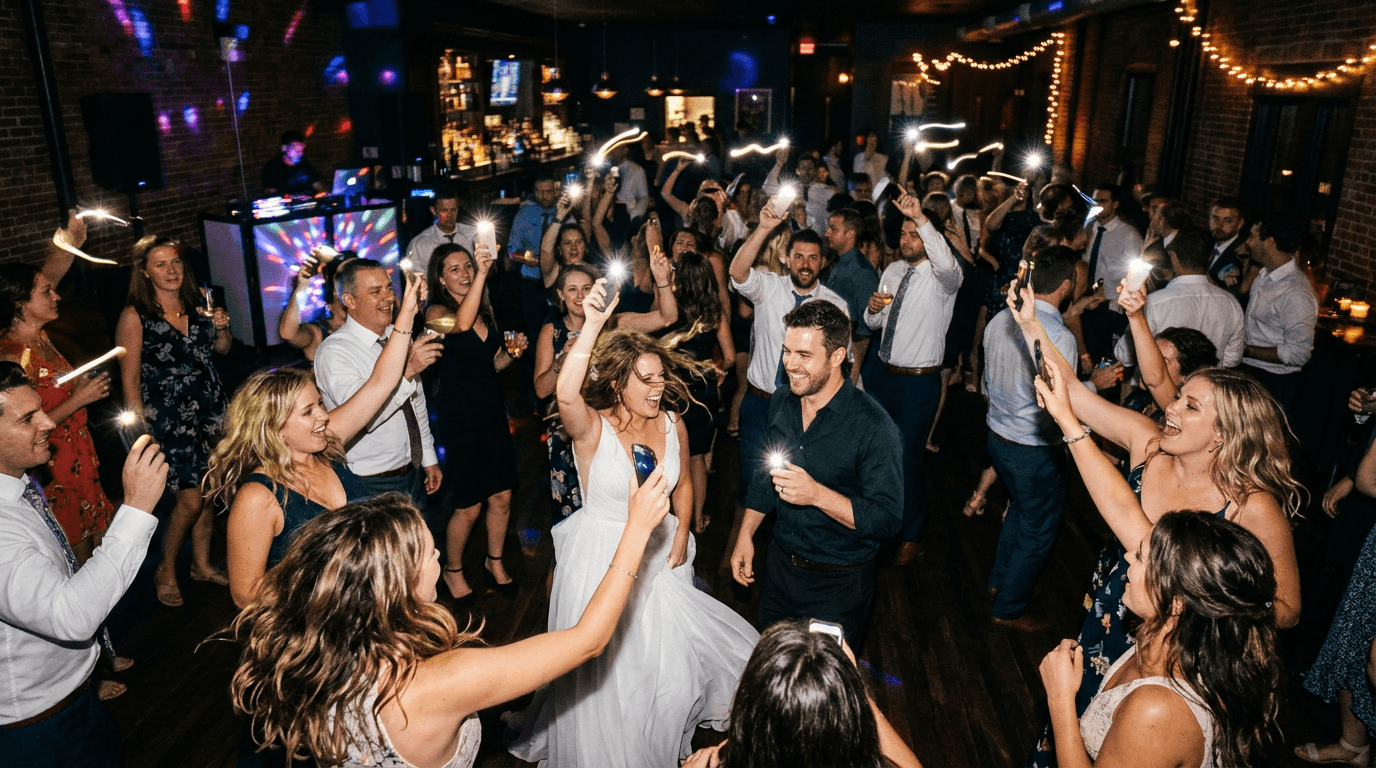
Every seat in the room is holding a camera. Give them somewhere to put it.
No subscriptions. One private home for every memory your guests share.